
Your MMR controls everything about your ranked experience in League of Legends, and Riot still won’t show it to you. Here’s lol mmr everything to know heading into the end of Season 2026, from how the hidden number actually works to the best tools for checking it yourself.
Last updated: October 31, 2026, patch 26.21
What Is MMR in League of Legends?
MMR, or Matchmaking Rating, is a hidden number Riot assigns to every League of Legends player. It determines who you get matched with in queue and directly controls how much LP you gain or lose after each game. Your rank is just the wrapper. MMR is the actual engine running your climb.
Riot keeps this number invisible on purpose. According to their official support page, MMR is built for the backend systems that create fair games, and pulling it out of them would make it less useful as a hard indicator of skill. Fair enough. But it also means most players have no idea why they’re gaining 18 LP one game and 14 the next.
I spent about 40 games stuck in Gold 2 earlier this year before I checked my MMR on a third-party site. Turns out my rating was sitting around high Silver. No wonder every win felt like pushing a boulder uphill. Once I understood the gap, I stopped tilting at the LP numbers and focused on stacking wins instead. Went on an 8-game streak and the gains jumped back to +22.

How Does MMR Work in LoL?
The math is simple on the surface. Win, and your MMR goes up. Lose, and it drops. But the size of each swing depends on who you beat or lost to.
Beat a team with higher average MMR than yours? Big boost. Lose to a team the system expected you to beat? Bigger punishment. Riot aims for every match to be roughly a 50/50 coin flip, give or take 1%, so in theory you’re always playing people close to your skill level.
Here’s what trips people up: MMR and rank are two different systems running in parallel. You can be Gold 3 with Platinum-level MMR, or Platinum 4 with Gold-level MMR. When your hidden rating outpaces your rank, the system pushes you upward with inflated LP gains and reduced losses. When your rank is higher than your MMR deserves, the opposite happens. Those painful +14/-21 games? That’s the system telling you to prove you belong.
Each queue has its own separate MMR too. Your Solo/Duo rating, Flex rating, normals, and ARAM are all tracked independently. Stomping ARAM games won’t help your ranked climb one bit.
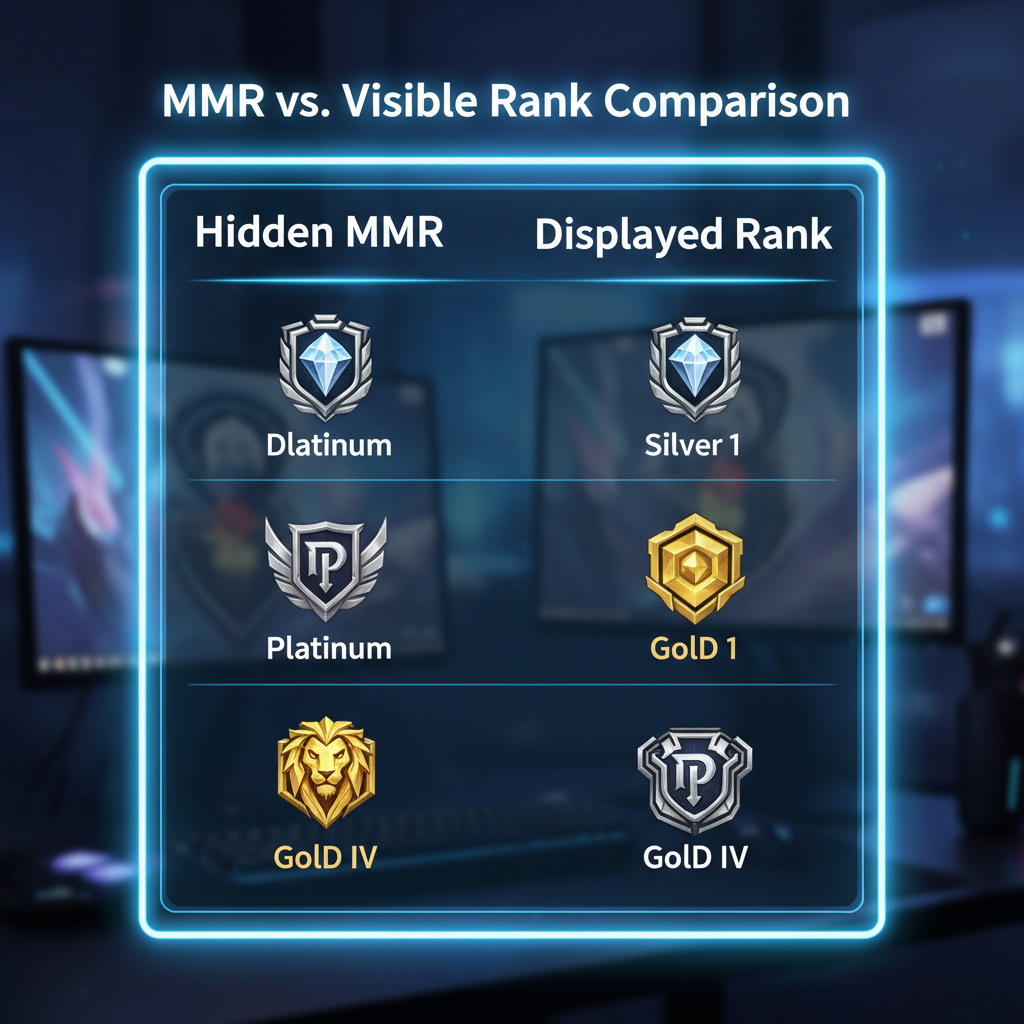
What’s the Difference Between MMR and Rank in LoL?
Rank is the trophy. MMR is the receipt.
Riot put it cleanly on its support page: “if MMR is your overall skill level, rank is a fluid representation of your current position on the path to fulfilling that potential.” You can read the full explanation in Riot’s MMR, Rank, and LP article.
Here’s how it plays out in your client:
- MMR > rank: bigger LP wins, smaller LP losses. The system is shoving you upward.
- MMR ≈ rank: roughly even LP gains and losses (think 18/18 or 20/22). You’ve found your floor.
- MMR < rank: tiny LP wins, brutal LP losses. You’re getting trimmed back down.
Does MMR Work the Same in Flex, ARAM, and Arena?
Different queue, different MMR. Each one tracks its own hidden rating, its own LP curve, and (for ranked queues) its own visible rank. Smashing flex with a 5-stack does nothing for your solo MMR. Sweating ARAM does nothing for either. Riot did pull the two ranked queues closer together in 2026, so a Master in Solo/Duo shouldn’t be sitting in Gold Flex lobbies anymore, but it says Flex will never pull Solo up.
Arena is the odd one out. It dropped ranked-style progression for Fame, a 12-level system based on how you perform and how far you go, so there’s no Arena tier to chase.
What Changed with MMR in Season 2026?
Riot made some serious moves this year. The /dev: Ranked 2026 blog post outlined several changes, and a few of them directly affect how MMR feels day to day.
Climbing Indicator (Patch 26.3): Riot added a visible signal, officially the Climb Indicator, that shows on the loading screen when a player’s MMR is ahead of their displayed rank. It’s not exact numbers (don’t get too excited), but it’s Riot finally admitting the gap exists. If you see it on your account, your LP gains should run bigger until your rank catches up.
Tier Recalibration: The two ends of the ladder got reshuffled. Riot acknowledged that today’s low-elo players are better than they were when these tiers launched, and its /dev: MMR-to-Rank Distribution post explains how it moved the more experienced Iron players into Bronze and put players at the higher end of Diamond into Master. If you felt like Bronze lobbies got harder this season, that’s likely why.
Aegis of Valor: Get autofilled with Aegis active and win? You’ll receive double LP for that game. Since patch 26.15 there’s no minimum mastery score, and Aegis no longer protects you on a loss. Support and jungle mains can get it too, at about the same rate as autofilled players.
Dodge Penalties at Master+: Dodging now counts as a full loss at Master and above, and Riot’s support page lists -20 LP plus an MMR hit. Below that, your MMR still isn’t affected by dodges. You still pay the LP and timer penalties, and at every rank your autofill now carries over to your next game instead of resetting.
How to Check Your MMR in League of Legends
Since Riot won’t show you the number, third-party sites are your only option. None of them have access to Riot’s actual MMR values. They’re estimating based on your match history, the ranks of players in your games, and your win/loss patterns.
Two popular LoL MMR checker tools right now:
- WhatIsMyMMR is the original. It’s been around for years and gives estimates for ranked, normals, and ARAM. Simple interface, no sign-up required.
- NoobHours is a newer option that’s built around the current ranked system. Fast and free.
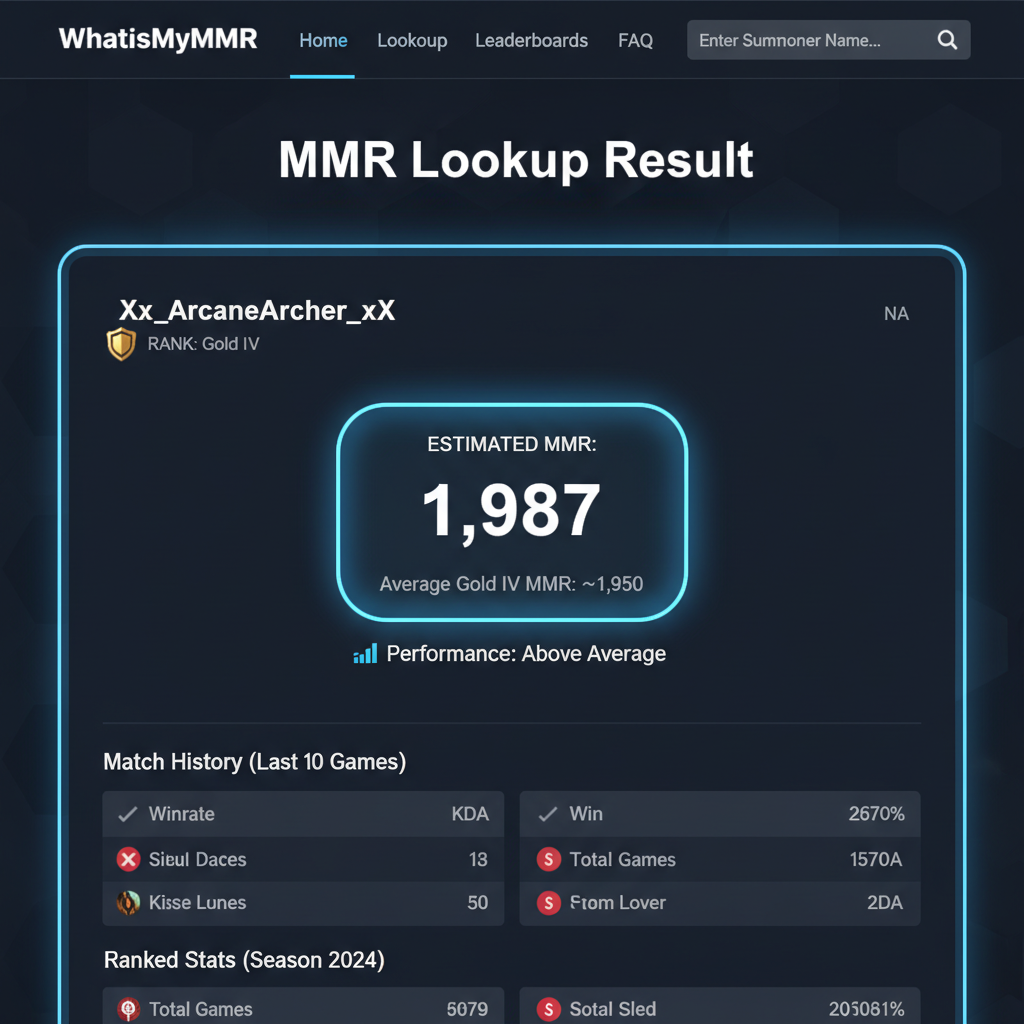
Don’t obsess over the exact number these tools spit out. They’re ballpark estimates. What matters is the trend. If every checker says your MMR is a full tier below your rank, you’ve got a problem. If they all say you’re above your rank, keep grinding because the system is working in your favor.
I ran my account through both after a 12-game session. WhatIsMyMMR had me at roughly 1,580 and NoobHours said around 1,620. Not identical, but both agreed I was sitting above my displayed Gold 1 rank. Good enough for me.
Tips for Actually Improving Your MMR
There’s only one real answer here. Win more. But let me break down what that looks like in practice.
Play fewer champions. Your MMR doesn’t care about your champion pool. It cares about wins. One-tricking or maintaining a pool of 2-3 picks lets you focus on macro instead of remembering ability combos. Check our guide on how ranked works in LoL if you want to understand the full ladder system.
Stop playing on autopilot. I know you’ve heard this before. Still true. Review your deaths after each game. Not all of them, just the ones where you died and had no idea what happened. Those are the ones tanking your winrate.
Dodge smart, not often. Below Master, dodging doesn’t hurt your MMR. It costs LP and queue time, but your hidden rating stays intact. If you see a lobby with two autofilled players and a first-time Yasuo, taking the -5 LP hit is worth it. Just don’t dodge more than once a day or the penalties stack hard: the second dodge costs 15 LP and a 30-minute timer.
Play during consistent hours. Queue times and match quality shift throughout the day. Late-night ranked is a different game than afternoon ranked. Find the window where you play best and stick to it.
If you’re hardstuck and need to climb fast for end-of-season rewards, LoL rank boosting exists for a reason. No judgment. Sometimes you just need the border.

Why Is My MMR Low and How Do I Fix It?
Low MMR happens for three reasons, and only two of them are fixable.
You lost a lot recently. Riot says multiple losses in a row tell the system your rank and MMR are out of sync, so you lose more LP per defeat until your win rate levels out. The fix is winning, not whining.
You play off-meta in a way that drags games. Picking Yuumi top into Darius will tank your win rate, your win rate tanks your MMR, your MMR tanks your LP.
Your account is genuinely at the right MMR. This is the unfixable one. If you’ve played 400 ranked games and you’re hardstuck Gold 4 with a 49% win rate, the matchmaker has a lot of evidence.
The mistake that costs the most LP is playing through tilt. Your MMR doesn’t reset overnight. Riot doesn’t publish how much weight each game carries, but a single tilted session of 5 losses at 3am can take a lot of wins to climb back from.
Why You’re Getting +14 LP Per Win
This is the question I see in every ranked discussion thread. Short answer: your MMR is lower than your current rank. The system is slowing your climb because it doesn’t think you belong where you are yet.
The fix isn’t complicated, but it takes patience. As a rough rule of thumb, you need a sustained winrate above 50% across 30+ games to push your MMR back up to match your rank. Not a 5-game win streak followed by a 5-game loss streak. Consistent, steady positive results.
If your account’s MMR is truly tanked from a bad loss streak, starting on a fresh LoL smurf account with clean MMR can be faster than grinding hundreds of games to repair the damage. Your placements on a new account reflect your current skill level, not your losses from three months ago.
I think Riot will eventually make MMR fully visible. The Climbing Indicator in patch 26.3 was the first step. They’re testing the waters. Showing a rough MMR range (not the exact number) would fix 90% of the frustration players have with the ranked system. Whether that happens next season or later is anyone’s guess.
That’s everything you need to know about how MMR works in League right now. The system isn’t perfect. But once you understand it, you stop blaming LP gains and start focusing on the one thing that matters: winning the next game.
FAQ
Does MMR affect normal games in League of Legends?
Yes. You’ve got a separate MMR for normals, ARAM, and each ranked queue. Your normal MMR won’t touch your ranked rating, but it still decides who shows up in your lobby. If your normal games feel harder than ranked, that’s why.
How many games does it take to fix bad MMR?
There’s no magic number. If your MMR tanked from a big loss streak, a rough rule of thumb is 30-50 wins above a 50% winrate to see real movement. The system changes gradually, not overnight, so you won’t fix a 200-game hole in a weekend.
Can you reset your MMR in League of Legends?
Not directly. Riot’s yearly rank reset lowers your rank, but Riot says your MMR stays where it was. Starting on a fresh LoL smurf account is the only way to get completely new MMR, since your main’s rating carries forward every season.
Why am I gaining less LP than I lose in LoL?
Your MMR is below the average for your current rank. The system thinks you’re ranked too high and is trying to correct it. You’ll need to string together wins to bring your MMR back up before LP gains normalize.
Is the LoL climbing indicator accurate?
It’s straight from Riot’s servers, so yes. Riot calls it the Climb Indicator. Enabled in patch 26.3, it shows on the loading screen when a player’s hidden MMR is ahead of their displayed rank. It won’t show you exact numbers, but it confirms the system thinks they belong higher.
Is MMR the same across solo queue and flex?
No. Riot tracks separate hidden ratings per queue, and Flex will never pull your Solo MMR up. Since 2026, though, Flex ranks sit closer to Solo/Duo ranks and the matchmaker looks at your Solo/Duo rank when building Flex games. ARAM has its own bucket too. Smurfing in flex won’t help your solo climb.